Livuzzle’s Life Sized Puzzles
Large as Life Livuzzle feature.
By Mya Parr, June 2026
Backstory of the Bison:
What started as an idea between family members gradually took shape into something much larger. While visiting Yellowstone National Park with her children. Co-founder Courtney was struck by a familiar scene: tourists ignoring “keep your distance” signs near wildlife. As an educator and parent, it raised the question: how do people truly understand scale, distance, and respect for the natural world?
Reflecting on that moment, Valerie explained:
“There were all these signs to stay away from the bison, and people ignore them all the time,” Valerie explained. “And Courtney thought: what if there was something you could take home, lay out on the floor, and actually see the scale of these animals compared to your own body?”
“We looked everywhere,” she said. “Online, in stores.. there was nothing like it. And we thought, I don’t think anyone has done this… but I love that idea.”
Built to Last
From the beginning, the goal was never to simply create another product.
“If we were going to do it, it had to improve on what’s already out there and actually add value to people’s lives,” Valerie said. “We weren’t going to make something just for the sake of making it,”
“We didn’t want something that gets used once, breaks, and ends up in a landfill,” she explained. “We wanted something that could last, something you could pass down to other kids, or another family.”
To achieve this, originally known as Large as Life–now known under the parent company of Livuzzle–the team chose to use thicker, more durable puzzle board despite the costs. It was a non-negotiable, something they refused to compromise on.
Their puzzles were also designed to extend beyond a one-time activity. With features like color-coded sections for collaborative play and integrated trivia, the intention was to create something that encourages repeated use and shared experiences.
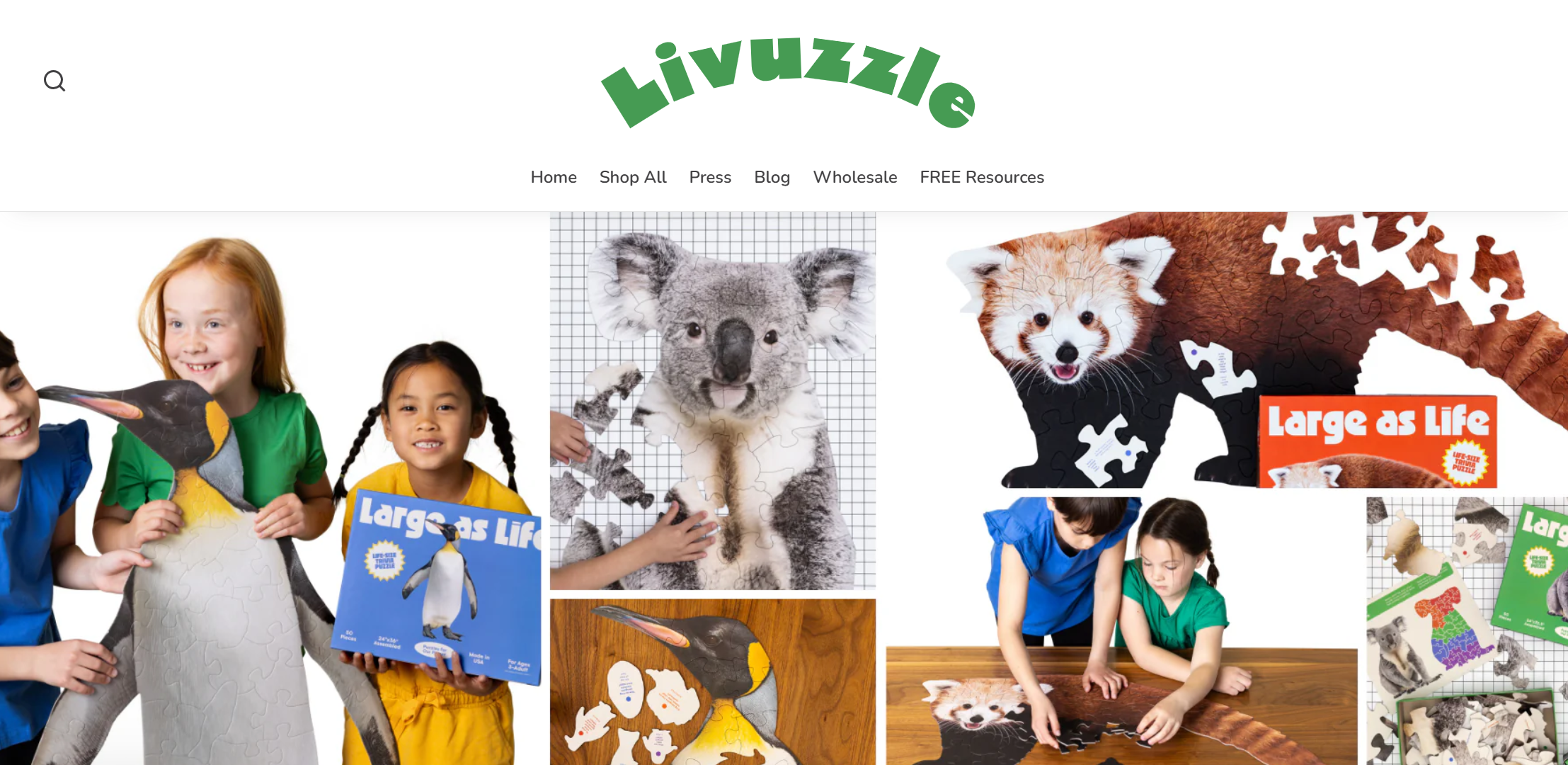
Image from https://livuzzle.com/pages/large-as-life
Pushing Back on “How It’s Done”
That commitment was tested almost immediately. Just weeks after receiving their first products, the team brought their puzzles to their first trade show, Toy Fest in 2024. What they anticipated to be a moment of excitement quickly turned.
“We had countless people tell us, ‘You’re never going to make it like this,’” Valerie said. “They told us we’d have to cut quality, make the pieces thinner, manufacture overseas, otherwise the margins wouldn’t work.”
Most of the feedback came from experienced business owners, and it wasn’t necessarily ill-intentioned, “I think they were trying to help,” she added, “we were brand new, we didn’t know what we were doing.” Yet still hearing it over and over again was a discouragement to say the least.
“We’d walk back to the hotel at the end of the day just feeling crushed,” she said.
At one point, they questioned whether the model was viable at all. But ultimately, they made a decision: if the business couldn’t exist without compromising its core values, it wasn’t to exist at all.
“We said, maybe this won’t work,” Valerie reflected. “But we’re going to give it our all and we’re not going to compromise on what matters to us,” including keeping production in the United States despite the challenges.
“We really didn’t love the idea of the carbon footprint that came with manufacturing overseas,” she said. “And we just thought there has to be another way.”
The Cost of Doing It Right
Like any business, Livuzzle faces trade-offs and often, those trade-offs challenge the very values that built the company.
One of the clearest examples came through their involvement with 1% for the Planet, an organization that commits businesses to donating a portion of their revenue to environmental causes.
“It completely resonated with us,” Valerie said. “We loved the idea of giving back as kids are learning about these animals,” but as a new business with tight margins, even well-aligned commitments can become difficult to sustain.
“We’re at a point where we might have to step back from it,” she admitted. “Not because we don’t care but because we have to make sure we can stay in business.”
A tension that many values-driven businesses face: creating a high-quality, durable product, manufacturing domestically, and maintaining environmental commitments, all while operating at a small scale, leaves very little margin for flexibility.
“We wanted to come out of the gate showing exactly what we stand for,” she said. “But right now, the margins are just really tight.”
Looking ahead, Livuzzle hopes to rejoin 1% for the Planet or similar organizations as the business grows.
The Reality of Building
Like many founders, Valerie described the transition from idea to execution as both exciting and overwhelming.
“It stretches your brain in ways you don’t expect,” she said. “You have this really idealistic vision—this beautiful idea about connection and learning—and then it’s like… shipping, logistics, marketing, getting people to even know you exist.”
Early on, the gap between building a product and building a business became clear. “We launched our website and were so excited,” she said. “We got a few orders from friends and family and then… nothing. Just crickets.”, followed by the realization that resonates with many early-stage businesses:
“It takes so much more work than you think to get people to know you exist.”
Success!
Now as most stories go, not every challenge ended in frustration. After overestimating demand for a seasonal product, the team found themselves with excess inventory, something that could have easily been written off as a loss. Instead, it turned into one of Valerie's most meaningful moments.
“There was a gentleman who reached out to me on Instagram,” Valerie said. “He was a father at an elementary school across the country, and he told me he was the president of their PTA.”
In his message, he described the realities his school was facing between limited funding, a high number of students in need, and a reliance on community-led efforts to fill the gaps. Their largest annual fundraiser, a Halloween themed “Monster Mash” was approaching, and they were looking for donations to support the event.
“He asked if there was any way we could donate some of our Halloween puzzles, an initial move that felt like a misstep, turned into an opportunity to do good for Livuzzle.
Instead of sitting in storage, the puzzles were shipped across the country and distributed to students, families, and classrooms.
“We were disappointed that we had overordered,” Valerie admitted. “But then it kind of fell into our lap, and I thought—this is exactly what we hoped for. It’s not going to waste. We’re able to use it in a positive way.”
“I could see through his posts how hard he was working,” she said. “All these parents volunteering their time, trying to support kids who really need it. And I just thought, "These kids are so lucky to have people like that in their corner.”
“We just want to make a positive difference,” she said. “And this felt like one of those moments where it actually happened.”
What They Want You to Know
At its core, Livuzzle is not just about puzzles, but connection.
“I want people to feel like there are real humans behind this,” Valerie said. “That we care not just about the product, but about the people using it.”
This shows up in small ways: responding personally to messages, engaging with feedback, and staying closely connected to customers, it also shows up in how they define their success.
“At the end of the day, I want to be able to look back and feel good about what we created,” she said. “Not just that we built a business but that we made something that actually adds value.”
Livuzzle challenges what it means to build something “successful.” In a market often driven by speed, scale, and convenience, their approach asks a different question: not just what can we sell, but what is worth creating.